Scalability & Maintenance : Belajarbina.online
Scalability & Maintenance
Designed Belajarbina to stay reliable as users and tiers grow by prioritizing structural separation over fragile conditional logic — minimizing day-to-day admin work while keeping access behavior predictable under caching and repeated logins.
Scaling Goal
Add users/tier complexity without rewriting access logic or increasing manual support
Maintenance Risk
Conditional-heavy restrictions create edge cases (cache, session, tier conflicts)
Design Priority
Low intervention ops: clear gates, clear routing, minimal “special handling”
1) Maintenance Pain Points
What typically causes WordPress LMS setups to become high-maintenance over time.
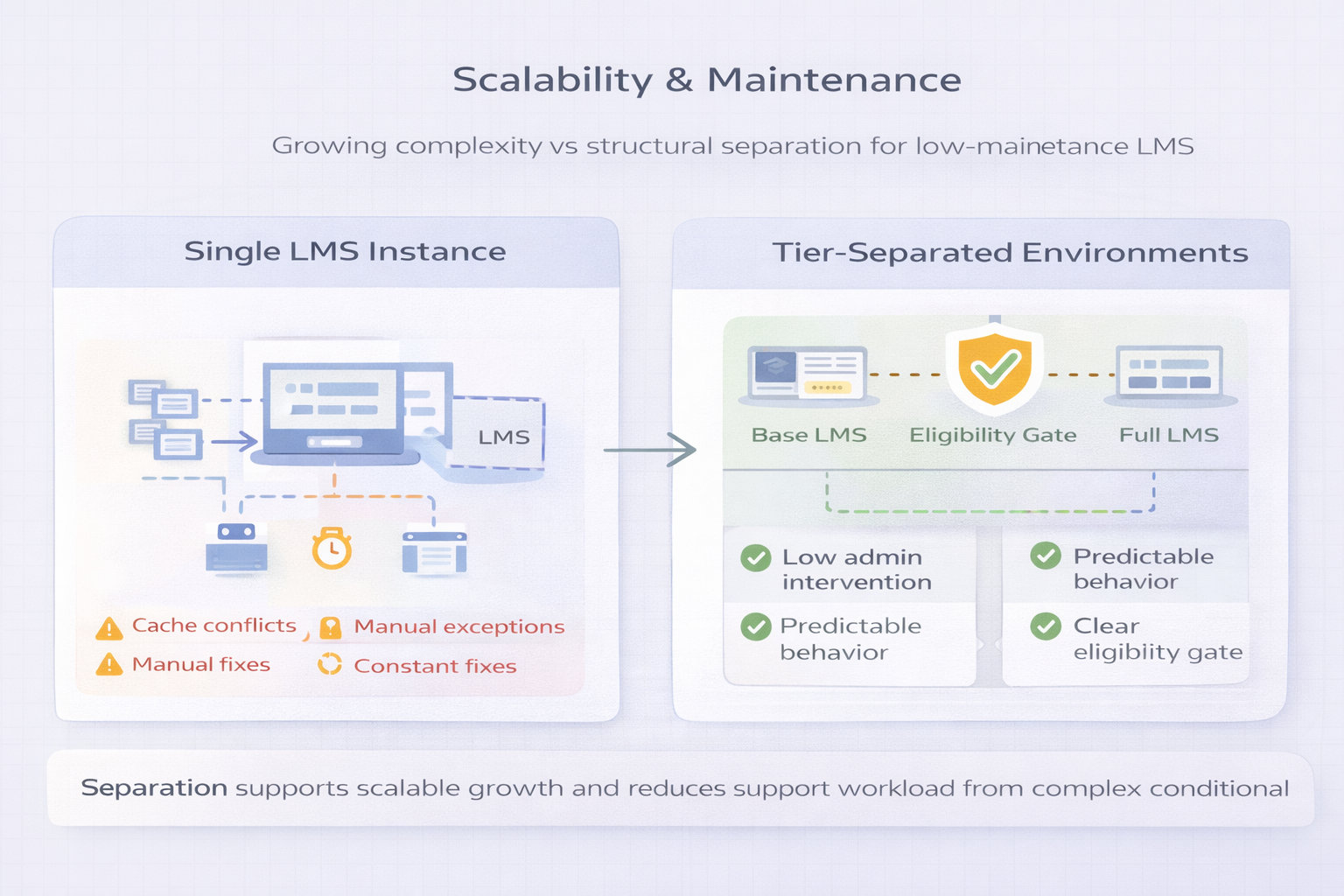
- Too many access rules inside one instance increases edge cases (tier + time + module)
- Cache/session behavior can create inconsistent views (“why I can’t access?” tickets)
- More tiers usually means more exceptions — which becomes admin-heavy without structure
- Systems break when they depend on constant manual configuration and “special handling”
2) Maintenance-First Design Choices
Decisions made to keep the system stable, understandable, and low-touch.
Structural Separation
- Separate environments by tier (Base vs Higher)
- Reduces conditional rendering inside one LMS
- Improves predictability under caching
Single Source of Truth
- WooCommerce order status controls eligibility
- Clear “deny-by-default” stance prevents accidental access
- Fewer ambiguous states = fewer support cases
Operational Clarity
- Users understand where to log in based on tier
- Expired/renew/upgrade states reduce confusion
- Less manual verification and ad-hoc fixes
3) Scaling Walkthrough
How the system handles growth without creating a maintenance burden.
Outcome (Qualitative)
The outcome is operational stability: fewer edge cases, less admin work, easier iteration.
- Lower support load: fewer access exceptions caused by conditional logic conflicts
- Predictable behavior: user access is consistent across sessions and environments
- Maintainable growth: adding tiers/modules doesn’t require reworking the entire system
Resulting system behavior
A maintenance-first LMS design: scale by separating complexity, not by stacking more conditional rules.